The digital publishing landscape is increasingly defined by the need for diversification. Relying solely on Google AdSense is no longer considered a sound strategy for professional publishers. As the industry shifts toward sophisticated programmatic ecosystems, the limitations of a closed, single-source revenue model have become glaringly apparent. This guide explores the transition from legacy networks to high-yield alternatives, providing a framework to optimize your inventory, improve site performance, and maximize long-term advertising revenue.
Why Publishers are Moving Beyond Google AdSense in 2024
The Limitations of a Single-Source Revenue Model
When a publisher commits exclusively to AdSense, they essentially create a single point of failure. The platform acts as a “walled garden,” where the publisher has limited visibility into the demand sources competing for their ad slots. This model restricts the ability to leverage competitive bidding, which is the primary driver of inventory yield in modern programmatic advertising. By relying on one partner, you limit the total bidding pressure, leaving significant revenue on the table.
Policy Sensitivity and the Risk of “AdSense Bans”
AdSense is notoriously stringent, often triggering “Limited” ad serving or sudden account suspensions due to minor policy infractions. For a content-driven business, a sudden loss of traffic monetization can be catastrophic. Diversification allows publishers to spread risk across multiple demand partners, ensuring that a single policy dispute does not result in a total cessation of income.
Seeking Higher Yield through Header Bidding and Diverse Demand
Header bidding forces multiple demand sources to compete simultaneously, driving up the final price paid for your ad inventory compared to a single-source model.
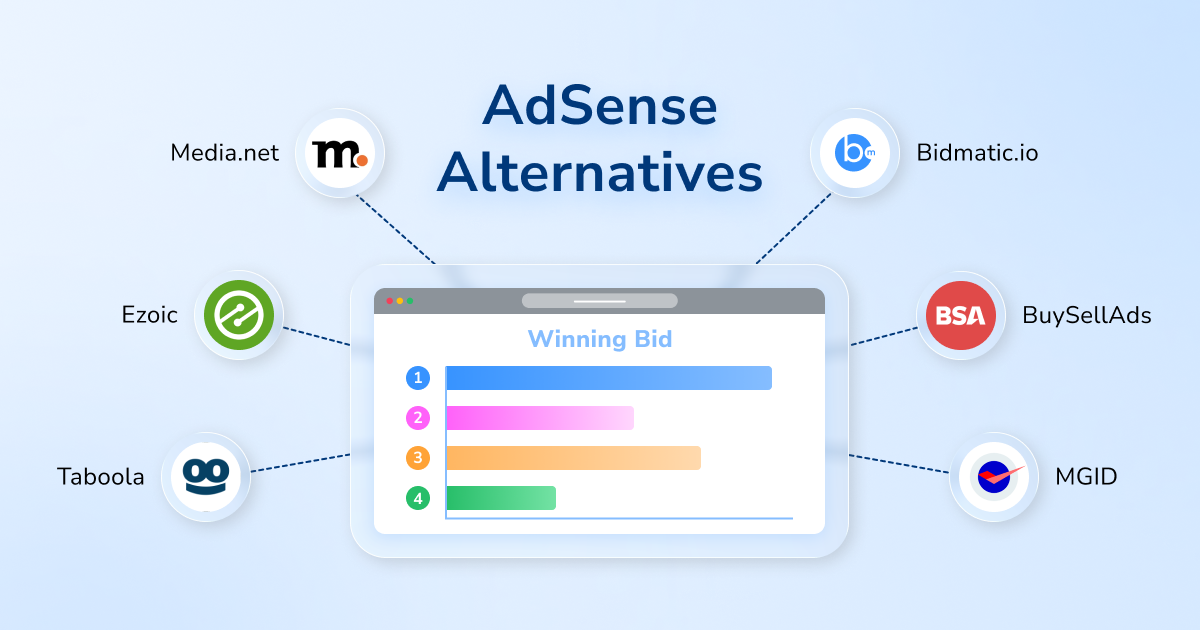
Header bidding has transformed the industry by allowing multiple ad exchanges to bid on an impression simultaneously. By moving to a multi-partner setup, publishers force demand sources to compete, driving up the bid price for every available slot. This creates an environment where quality content is rewarded with higher eCPM, effectively shifting the monetization strategy from passive reliance to active optimization.
Key Criteria for Evaluating AdSense Alternatives
Understanding Monetization Metrics: RPM vs. CPM
To evaluate potential partners, publishers must distinguish between Revenue Per Mille (RPM) and Cost Per Mille (CPM). CPM refers to the cost an advertiser pays for 1,000 impressions, while RPM represents the revenue a publisher earns per 1,000 pageviews. A high CPM is useless if the partner’s fill rate is low. Always prioritize the partner that demonstrates consistent, high-yield results across your entire site traffic.
Payment Terms and Reliability: From Net-30 to Net-65 Schedules
Cash flow is the lifeblood of any digital operation. Some networks offer Net-30 terms, while others push payments to Net-65 or beyond. When selecting a partner, consider their track record of reliability. Consistent monthly payments are essential, especially when scaling your operation and managing operational expenses.
Global Demand and Performance Across Different Geographies
Ad networks vary significantly in their ability to monetize international traffic. If your site has a global audience, ensure your chosen platform has robust demand in your core geographic markets. An effective partner will optimize targeting to ensure high-value ads are served regardless of the visitor’s location.
Impact on Site Speed and Core Web Vitals (UX)
Modern advertising must not compromise user experience. Heavy ad scripts can devastate site speed, negatively impacting your Google search rankings. Always prioritize partners that offer lightweight SDKs or asynchronous loading, ensuring that ad quality does not come at the expense of page speed or Core Web Vitals.
Navigating the Monetization Journey
Level 1: Entry-Level Alternatives for Developing Sites (Under 50k Monthly Pageviews)
For smaller, developing sites, the priority is ease of integration and low barriers to entry. Platforms like Adsterra provide near-instant approval, allowing publishers to monetize traffic immediately without complex configuration requirements.
Level 2: Growth-Stage Networks for Scaling Publishers (50k–100k Pageviews)
As your site scales, you need more sophisticated tools. Networks like Ezoic and Mediavine offer superior yield optimization. Ezoic, in particular, leverages AI to test layouts, ensuring that ad placements are optimized for both user engagement and revenue.
Level 3: High-Performance Solutions for Enterprise and High-Traffic Sites
Enterprise-level publishers require full control over their ad stack. This includes header bidding management, direct deal access, and technical transparency. Here, solutions like PubMatic or specialized programmatic partners become essential for maintaining high yield.
Best AdSense Alternatives
Mediavine
The Standard for Lifestyle and Content-Rich Sites
Mediavine focus on high-quality lifestyle content. They offer excellent support and curated demand, making them ideal for publishers who prioritize brand safety and user-friendly ad placements.
Ezoic
Leveraging AI for Layout and Yield Optimization
Ezoic’s platform uses machine learning to identify the best ad configurations for individual users. This data-driven approach often results in a higher yield compared to static ad placements, provided the publisher is comfortable with the platform’s automated optimization features.
Adsterra
High Fill Rates and Near-Instant Approval for Global Traffic
Adsterra is a standout for those needing global scale. Its high fill rates ensure that nearly every impression is monetized, which is particularly effective for sites with diverse, international traffic patterns.
PubMatic
Advanced platforms for enterprise and mid-size publishers
For publishers comfortable with managing their own ad stack, PubMatic provide the granular tools necessary for sophisticated bidding strategies. The platform are designed for high-traffic sites that require total transparency and control.
Primis
Specialized Video Units for Engagement
Playwire focus on high-engagement video units that can be integrated seamlessly into text-heavy pages. These tools help publishers capitalize on the higher CPMs associated with video advertising without needing to produce extensive video content themselves.
Teads
Balancing Native Ads with Video Content
Teads (Outbrain) offer a hybrid approach, combining native recommendation widgets with video advertising. This balance helps maintain user engagement while diversifying revenue streams beyond standard display ads.
Bidmatic as AdSense Alternative
- Transitioning from Managed Services to a Publisher-First AdTech Solution
Bidmatic.io represents a significant shift toward transparency. Unlike traditional “black box” networks, Bidmatic provides a publisher-first approach that prioritizes data access and infrastructure control. - The Importance of Transparency: Global Placement ID (GPID) and Identity Solutions
Transparency is the bedrock of Bidmatic’s value proposition. By utilizing Global Placement ID (GPID), Bidmatic ensures that publishers know exactly where their inventory is being sold. This transparency is crucial for maintaining inventory quality and preventing fraud. - Maximizing Video ROI with Specialized Demand Sources
Bidmatic optimizes video yield through access to premium demand sources, ensuring that your video inventory is not just filled, but sold at the highest possible market price. - Intuitive Dashboard and Real-Time Reporting: Moving Beyond the “Black Box”
One of Bidmatic’s core strengths is its real-time dashboard. Publishers no longer need to wait for end-of-month reports to understand their performance; the platform offers the data necessary to make informed, split-second decisions about their ad inventory. - Ease of Integration: Minimizing Operational Friction
Bidmatic is built for the modern developer. Its lightweight, efficient integration process minimizes the impact on site performance, ensuring that your technical team can deploy, test, and scale without excessive overhead.
Operational Hurdles: What to Watch Out For
When moving to a new partner, always review the terms of service carefully. Pay close attention to the minimum payout thresholds and the frequency of payments. Avoid providers that lack a clear, professional support channel, as technical issues are inevitable in programmatic advertising.
Final Thoughts
The transition away from a single-source AdSense dependency is a necessary evolution for any professional publisher. By focusing on diversification, transparency, and high-yield video inventory, you can stabilize your revenue while enhancing the experience for your users. Start by assessing your current site maturity, then test new demand sources through a phased approach. Remember that modern monetization is a continuous process of testing and optimization. By leveraging tools that offer real-time reporting and granular control, such as Bidmatic.io, you can move from merely placing ads to effectively managing an automated, high-performing digital asset. Prioritize site speed, ensure your inventory remains high quality, and remain agile as the ad-tech landscape continues to shift.