Have you ever checked your ad dashboard, seen your RPM trending upward, yet felt confused because your total monthly payout remained stagnant? You are not alone. This “Revenue Paradox” is the most common frustration for modern website owners. Understanding the mechanics of ad revenue requires looking past surface-level figures to see how different metrics influence your actual bank balance.
Why Your Earnings Don’t Always Match Your Metrics
The Confusion Between Advertiser Cost and Publisher Profit
Understanding the difference: CPM is what advertisers pay for impressions, while RPM is what publishers earn per pageview.
The disconnect often stems from mixing up the buyer’s perspective with the seller’s perspective. Advertisers focus on the cost to reach users, while publishers must focus on the aggregate yield generated by their platform. When you mistake a cost-based metric for a profit-based metric, you lose sight of your true performance.
Why This Distinction Matters for Your Bottom Line
Metrics like CPM and RPM are not just vanity figures; they are tools for business health. If you optimize for the wrong indicator, you risk degrading your user experience or leaving money on the table through poor ad placement strategies.
Decoding CPM
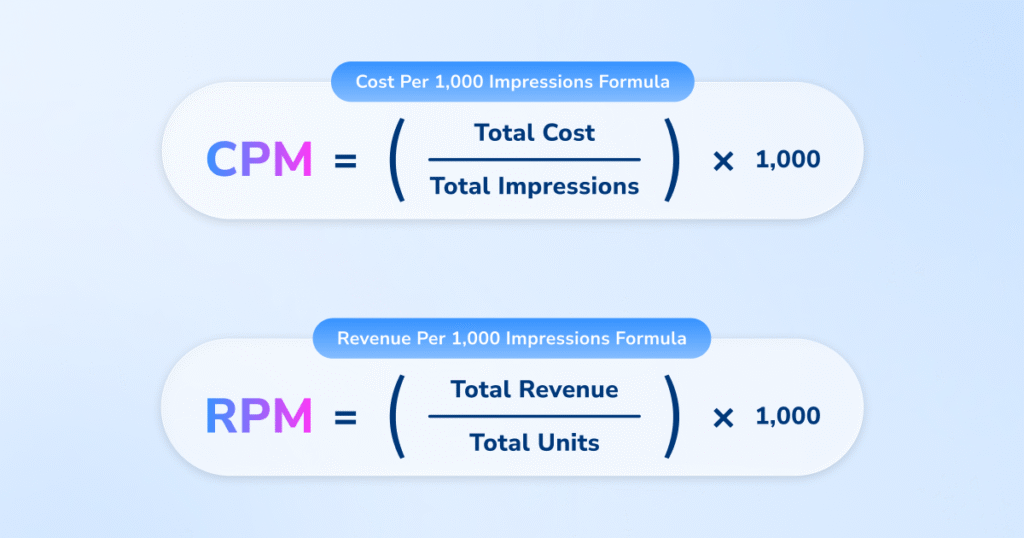
CPM stands for “Cost Per Mille” (cost per thousand). It is the price an advertiser pays for 1,000 ad impressions. The formula is:
Total Ad Spend / (Total Impressions / 1,000) = CPM.
It represents the cost of visibility for the advertiser.
The Role of vCPM (Viewable CPM) in Modern AdTech
Modern adtech has evolved to vCPM. Advertisers now demand that an ad is actually seen – not just loaded – before they pay. This shift forces publishers to prioritize placements that are above the fold or in high-engagement areas.
CPM is the primary metric for brand awareness campaigns. Because advertisers want to control costs across various placements, they set a fixed price they are willing to pay for every thousand views of their creative.
For a publisher, CPM is merely an input cost. A high CPM does not guarantee high earnings if your site has low traffic or poor ad density. Focusing solely on CPM ignores the volume of ads shown per session.
Decoding RPM
What is RPM? Definition and the Revenue-Focused Formula
RPM stands for “Revenue Per Mille.” It measures the revenue a publisher earns per 1,000 pageviews. The formula is:
(Total Earnings / Total Pageviews) * 1,000.
It provides a much clearer picture of your monetization efficiency.
Page RPM considers all revenue generated on a page, while Ad RPM focuses on the revenue per specific ad unit. Understanding both is critical for testing which placements yield the best returns.
RPM accounts for every ad on your page and every visitor. It allows you to see the real impact of seasonal trends or site changes on your total income.
Why High CPMs Can Sometimes Lower Your Total Revenue
- How Unsold Inventory Dilutes Your Earnings. If you target only the highest-paying CPM advertisers, you may face a low fill rate. When ads aren’t displayed, your total inventory sits empty, and you earn zero dollars on those slots.
- The Danger of Ad Overload: Balancing Ad Density with User Experience. Flooding a page with too many units can increase your total RPM temporarily but may spike your bounce rate. If users leave because your site is cluttered, your long-term traffic and total revenue – will plummet.
- How High-Value Keywords and Niche Targeting Influence Both Metrics. Niche websites often attract high-paying advertisers, driving up both CPM and RPM. However, the quality of your traffic is what ultimately determines if those high-value ads actually convert.
The Rise of EPMV and Session Revenue
EPMV (Earnings Per Thousand Visitors): The Microscope for Site Growth
EPMV is the “Holy Grail” of metrics. It measures earnings per thousand visitors rather than per pageview. It reveals how many ads a user sees during an entire session, providing the most accurate view of your total revenue potential.
Why Session Revenue is the Ultimate Indicator of Long-Term Site Health
Session revenue tracks the total value of a user’s entire journey. By maximizing what a visitor contributes during their stay, you align your strategy with sustainable site growth.
Tracking the “Big Picture” Using Google Analytics and Ad Revenue Analysis
Integrate your ad stack with analytics to see exactly which pages contribute the most to your bottom line. This helps you double down on high-performing content.
How to Improve Your Revenue Metrics Without Killing Your Traffic
- Improving Ad Viewability and Placement Strategy. Move ads into the user’s natural line of sight. Higher viewability leads to higher advertiser demand and better bids.
- The Importance of Traffic Quality and Audience Segmentation. Focus on attracting audiences that advertisers crave. High-intent traffic always commands better rates than passive, casual browsing.
- A/B Testing Your Ad Layout: Finding the “Sweet Spot” Between Yield and UX. Continuously test your ad density. Small adjustments to placement can significantly improve your RPM without frustrating your audience.
- Leveraging Header Bidding and Diverse SSPs to Increase Competition. Header bidding allows multiple exchanges to bid on your inventory simultaneously. Increased competition ensures you receive the highest possible price for every impression.
Conclusion
True ad revenue is not found in a single number but in the relationship between your traffic quality, user experience, and inventory management. Stop chasing high CPMs in isolation. Instead, adopt a holistic strategy that uses RPM for daily monitoring and EPMV for long-term growth. By focusing on the entire visitor journey, you ensure that your site remains profitable, scalable, and resilient against market fluctuations.